
Sullivan Warrant Checks
Sullivan has no city warrant portal, and Indiana's current directory lists no municipal court here. A good Sullivan warrant check therefore pulls together several official records. Gather the full legal name used in court, any cause or citation number, the filing year, and any notice you received. Begin with Indiana MyCase. Then confirm the result with the Sullivan County Clerk. The public chronology may show a warrant, failure to appear, bond, recall, service, or disposition, but it is not a live police warrant register.
- Search MyCase by exact name and cause number, then filter to Sullivan County and the likely case type.
- Call the Clerk at 812-268-4657 for the official file and court assignment.
- Call Superior Court at 812-268-6939 for traffic and misdemeanor matters.
- Ask the Sheriff at 812-268-4308 to confirm process or custody status.
- For a city citation, use City Dispatch at 812-268-4353 only to identify police routing, then return to the court.
Sullivan Warrants Without City Court
With no Sullivan municipal court listed, the route changes. City Hall publishes ordinances and city records, while the Sullivan Circuit and Superior Courts keep judicial cases through the county Clerk. A citation does not become a City Hall warrant file just because Sullivan police wrote it. Ask where the citation was filed and which cause number controls it. The local allocation plan sends traffic infractions and all misdemeanors to Superior Court. Felonies may land in Circuit or Superior, so the charge alone will not pick the office for you. The cause number and the Clerk's assignment save you from calling the wrong room.
Key point: No city court listing does not mean no Sullivan warrant exists. It means the state-court record must be checked.
Policing and Courts in Sullivan
The Sullivan City Police Department patrols the city, enforces city and state law, makes arrests, and transports prisoners. For non-emergency calls, City Dispatch takes them at 812-268-4353. Emergencies still go to 911. The department publishes no warrant lookup and no separate warrant-desk number, so dispatch is a routing contact rather than proof of status. The official police page lays out that public routing information.
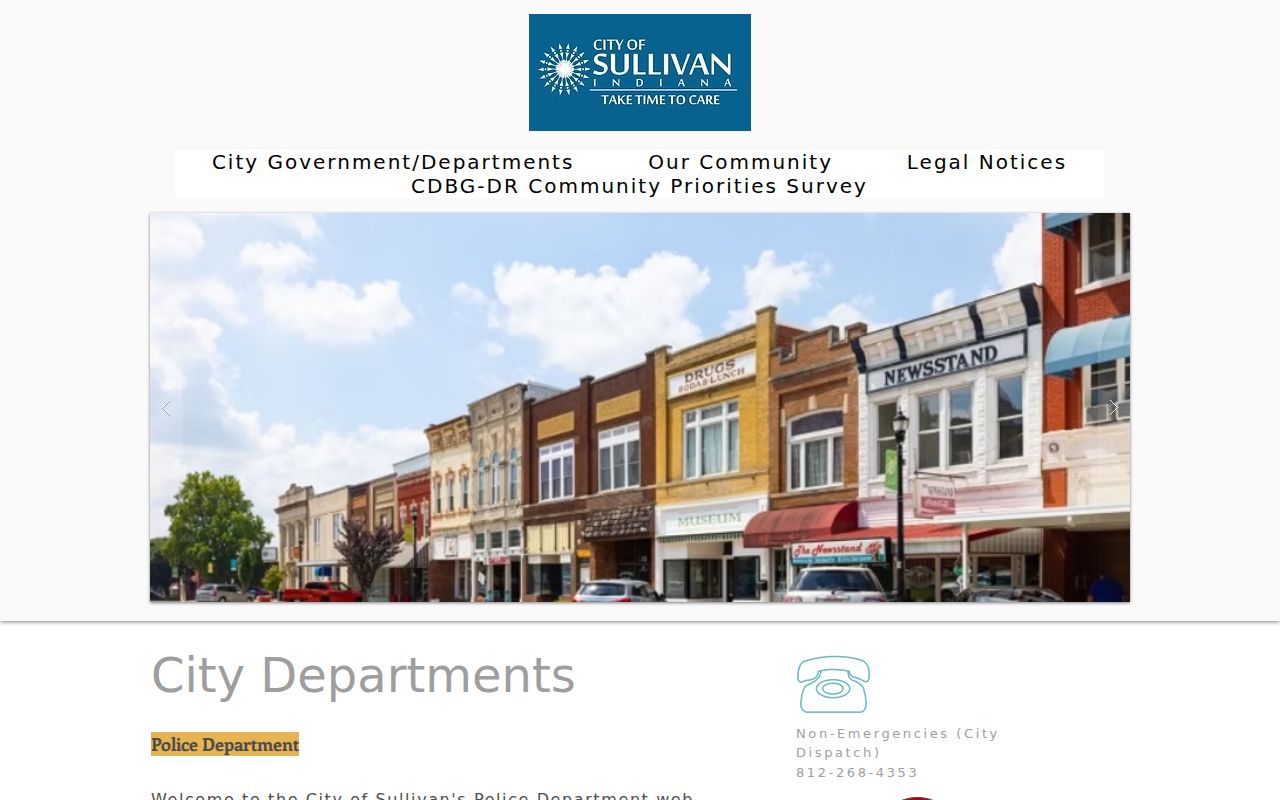
That page supports a police contact. It does not make the department site a warrant database. The Sullivan County Clerk keeps the court file at 100 Courthouse Square. Superior Court is the main contact for a Sullivan traffic citation or misdemeanor. Circuit Court may hold an assigned felony. Police can make a lawful arrest, and the Sheriff can execute county process. Only the issuing court can recall a warrant, reset a hearing, or enter a disposition.
Sullivan Warrant Questions at City Hall
Sullivan City Hall sits at 110 North Main Street, Sullivan, IN 47882, with a public phone of 812-268-6077. It helps with ordinances, city documents, and finding the city office tied to a local notice. It is not a warrant counter. The official city portal shows Sullivan's civic contact context.
The city image helps identify the municipal source, while warrant status still comes from the Clerk and the assigned court. Keep any receipt a city office gives you. Payment to a city clerk does not by itself prove a court warrant was recalled. Ask the court to confirm the docket entry, the disposition, and any compliance report. The distinction matters. A city ordinance, a court case, and a BMV record can each track a different part of the same event.
Warrants in Sullivan: Main Types
Sullivan warrant records use standard Indiana terms. A bench warrant often follows a missed court duty. An arrest warrant rests on a charging and probable-cause process. A traffic FTA warrant can arise after a failure to appear or answer. A search warrant authorizes a search and is not a warrant telling a person to surrender.
| Warrant Type | How It Arises | Who Issues It |
|---|---|---|
| Traffic FTA | Missed answer or appearance on a qualifying citation | Sullivan Superior Court |
| Bench warrant | Missed hearing or failure to follow a court order | Assigned Circuit or Superior Court |
| Arrest warrant | Criminal charge and judicial probable-cause finding | Circuit or Superior Court |
| Search warrant | Probable cause to search a named place, person, or thing | Authorized judicial officer |
Sullivan Citation Status
A citation issued in Sullivan may be filed as an infraction, ordinance violation, misdemeanor, or another case type. If the first MyCase query comes up blank, search more than one category. When the cause number is unknown, ask the Clerk to search by citation number. A blank result can reflect spelling, a recent filing, an older converted event, or a record with access limits. For traffic matters, ask Superior Court whether appearance, payment, a new date, or a warrant recall is required. Indiana Code 9-30-3-8 also allows court reporting to the BMV in qualifying FTA matters. Treat court compliance reporting and warrant status as two separate checks. One should not be inferred from the other.
Sullivan Warrant Records: What They Show
A Sullivan case chronology can reveal the pieces you need to ask a precise status question. MyCase may not display the paper warrant itself. Record the cause number, court, event date, bond entry, next setting, and any service or recall entry. When online documents are limited, the Clerk-held file remains the official record.
| Cause number | Exact identifier, often carrying county code 77; copy it rather than guessing its full form. |
|---|---|
| Case type | Infraction, ordinance, misdemeanor, felony, or another docket category. |
| Warrant event | Issue date, FTA reason, judicial officer, and related order when public. |
| Issuing court | Sullivan Circuit Court or Sullivan Superior Court. |
| Bond or payment | Amount and type only if the current court record states them. |
| Status | Issued, served, returned, recalled, quashed, or disposed, as confirmed by court and Sheriff. |
Two Sullivan Status Checks
A court entry and an operational law-enforcement record answer different questions. The Clerk and issuing court can state whether an order recalling or quashing the Sullivan warrant was entered. The Sheriff can state whether the executable process record has updated. Keep the order or receipt. Ask both offices for current status before relying on a web result.
- Recall
- The issuing court withdraws the warrant.
- Quash
- The court sets aside the warrant by order.
- Return
- Law enforcement reports how process was handled.
- FTA
- Failure to appear for a required court event.
Sullivan Warrants and Sullivan County
Sullivan keeps its city and county offices within a few blocks, but the roles stay distinct. City Police can open a case and serve papers. The county Clerk holds the judicial file. A warrant comes from Circuit or Superior Court. Only that court can change it. The Sheriff handles county process and custody, Indiana offers no statewide public criminal warrant search, and MyCase remains a case-information tool.
Warrant flow: Sullivan Police or filing agency › Sullivan Circuit or Superior Court › Sullivan County Clerk › Sullivan County Sheriff.
The Sullivan County warrant records page covers county routes. A city resident should still keep three numbers apart. The citation, the police incident number, and the court cause number each matter, because one office may search by one and not the others.
Resolving a Sullivan Warrant
Skip the unplanned walk-in. Sullivan offers no official surrender window, warrant-recall form, or city payment interface, so plan the first call instead. Call the Sullivan Clerk and the issuing court. Ask what the case needs, whether that is a new hearing, a motion, payment, bond, an attorney-arranged appearance, or another compliance step. If custody is possible, consult an Indiana defense lawyer. After you act, get the court order, the receipt, and the next date. Confirm the recall or service entry with the Sullivan court. Ask the Sullivan Sheriff whether its record changed too. A payment can settle a balance while an appearance duty remains, and a BMV FTA suspension can persist until the court reports compliance.
Caution: City Hall payment, MyCase payment, warrant recall, and BMV compliance are separate events unless the court confirms otherwise.
Accessing Sullivan Warrant Records
The Indiana Access to Public Records Act lets you request existing, releasable records from a Sullivan office. Describe the record with reasonable detail. The act binds Sullivan City Police, the Sheriff, and the courts to release existing records only. It never forces a new warrant list. Court records also follow Indiana's Rules on Access to Court Records. Sealed material is protected. Expunged, juvenile, and active-investigation records can be withheld or limited too.
Key Rules:
Indiana court public-record guidance directs users to MyCase and the Clerk.
The public-access matrix shows why some case types and documents stay offline.
A written APRA request should identify the record, date range, issuing agency, and your own cause number without asking for a new roster.
Sullivan City Payment Boundaries
Tie every payment to the exact Sullivan case. MyCase shows a "Make a payment" control only when an Indiana court enables it for that case, and the official help warns that not every obligation can be paid online. City Hall may collect sums tied to city business. Neither screen settles a warrant. Ask Superior Court or the assigned court for the full amount, the accepted method, and any appearance requirement. Keep the dated receipt. Compare it with the next docket entry. A traffic FTA that reached the BMV needs one more step. Ask the Sullivan court to report appearance, disposition, or payment compliance, as the controlling law requires. Then confirm the warrant event with the court. Check the process record with the Sullivan Sheriff. These checks keep a Sullivan resident from mistaking one payment screen for a full clearance.